
What you have to know about ski jumping
A for artificial slope
The International Ski Federation (FIS) has been organising the summer Ski Jumping Grand Prix on an artificial slope since 1994. The in-run tracks are made from porcelain covered in water and the landing area consists of plastic mats. Summer ski jumping was originally developed in the GDR in 1954 to enable ski jumpers to train in summer as well. In Switzerland, there are summer ski jumps in Einsiedeln and Kandersteg, as well as a few children’s ski jumps that also fitted with plastic mats.
B for body mass index (BMI)
The BMI formula – body weight in kg divided by the square of body height in metres – determines the maximum ski length for each individual athlete. According to the regulations, a BMI of at least 21 is required to be allowed to jump with the maximum ski length of 145 per cent of one’s height. From the 2023/24 season onwards, athletes will be weighed without their jumping suits and boots. Anyone falling below this threshold must use shorter skis – and thus loses lift.
C for Continental Cup
The Continental Cup is an international competition series below the World Cup and is often referred to as the ‘second division’ of ski jumping.
D for disqualification
Anyone who breaches the regulations of the International Ski Federation (FIS) or fails to comply with the competition rules and instructions issued by the jury will be penalised by the jury. The most common reason for disqualification is equipment. If the ski suit is found to be too large during the check, the jump will be excluded from the results. Since the 2025/26 season, a card system similar to that in football has been in place: the first disqualification for equipment-related reasons results in a yellow card; a second offence leads to a red card and, consequently, a suspension. The team is not permitted to fill the vacant starting place.
E for eyes on the time
The start of a jump is divided into three different phases represented by a traffic light system. Athletes get to prepare for their jump during the red phase, before heading to the start gate when the light turns to amber. After a minimum of 20 seconds, the light switches to green. The athletes then have ten seconds to leave the start gate.
F for flight curve
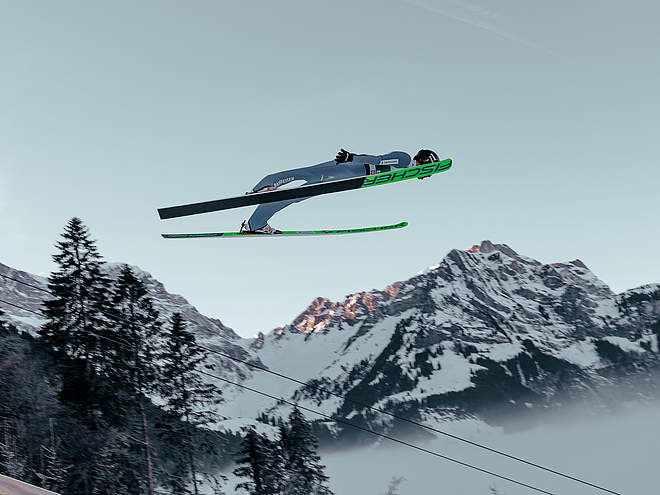
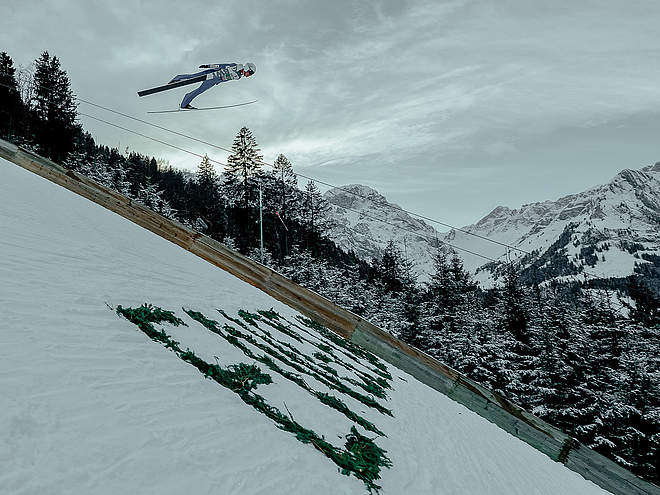
The flight trajectories of jumpers vary depending on their technique, strength and body weight. The run-up speed and the prevailing wind have the greatest influence.
G for gate factor
During a round, the judges can adjust the run-up length to respond to changing conditions. To ensure the competition remains fair, this is compensated for: competitors who have to jump from a lower starting platform are awarded extra points, whilst those starting from a higher platform have points deducted. Wind conditions are also taken into account: points are added for a tailwind and deducted for a headwind.
I for in-run
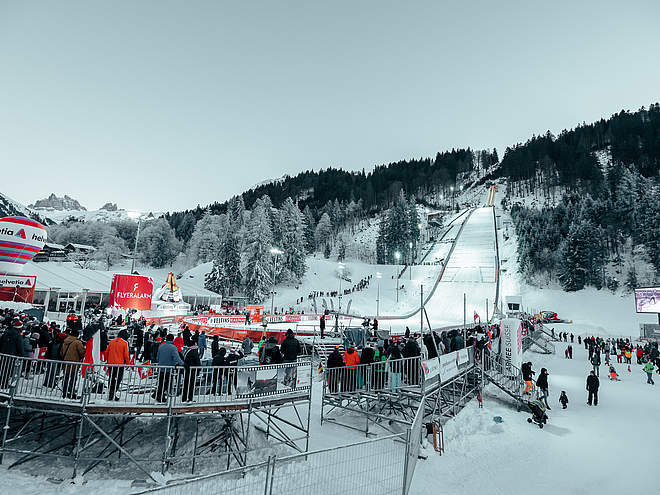
The speed that ski jumpers reach on the in-run is the main factor determining how far they jump. Each extra km/h in speed can equal an extra metre or more in distance. Standard ski jumps like the one in Engelberg usually generate in-run speeds of around 90 km/h. In ski flying, athletes can reach speeds of over 100 km/h.
J for Jury
The jury consists of the FIS Race Director, the FIS Technical Delegate (TD) and his assistant, as well as the organiser’s competition director. Among other things, it decides on the inrun length and whether jumps can take place in difficult conditions.
K for K-Point
The calculation point (K-point) for each ski jump forms the basis for the distance points. On the Gross Titlis ski jump, it is set at 125 metres (K 125): anyone who jumps exactly that distance receives 60 points. For every metre further, 1.8 points are added; for every metre shorter, 1.8 points are deducted.
L for Landing
Particularly high marks for manoeuvrability are awarded when the flight and landing flow seamlessly into one another. That’s not at all easy at landing speeds of over 100 km/h.
M for measuring distances
The distance jumped is measured with digital cameras and analysed on computers. This system, which replaced distance judges only a few years ago, gives incredibly accurate distance measurements. A leader in this field, Swiss Timing also provides distance measurements and analyses in Engelberg.
N for night ski-jumping
Competitions under floodlights have become increasingly common in recent years. One advantage is that wind conditions are often calmer in the late afternoon and early evening. Night-time ski jumping has a long tradition in Engelberg: competitions under floodlights were held here as early as 1964. Since 2016, a new floodlight system has also made it possible to hold evening competitions on the Titlis ski jump.
O for olympic discipline
Ski jumping has been part of the Winter Olympics since 1924. Women have been competing since 2014 in Sochi, and a mixed team event has also been held since 2022.
P for Points
Every run is marked. Of the five posture marks, the highest and lowest are discarded, and the three in the middle are added together – this gives a maximum of 60 points. Added to this are the distance marks as well as any bonus points or deductions for run-up length and wind (see G).
Q for Qualification
Since the 2017/18 season, all athletes have had to go through the qualifying rounds – even the World Cup’s top performers. In the men’s event, 50 athletes make it through to the competition; in the women’s, 40.
S for style scores
Five judges from different countries award a maximum of 20 points per jump. They judge the flight phase and, above all, the landing. If the athlete fails to land in the Telemark style (see “Telemark” section), the jury will deduct up to four points. Flailing arms in the flight phase will lead to a deduction of 0.5 to five points, while a fall could cost up to ten points.
T for take-off table
It’s all or nothing once you reach the take-off table – only the athletes who have a perfect take-off can achieve great distances. Achieving the perfect take-off is all about technique, strength and optimal timing. The take-off table typically has angle of inclination of 10.5 to 11 degrees.
V for V-style
In the late 1980s, the Swede Jan Boklöv became the first to spread his skis into a V-shape whilst in the air. The technique, which was initially highly controversial – the judges deducted points from his style score for it – nevertheless secured him the overall World Cup title in the 1988/89 winter season. The Swiss skier Stefan Zünd was among the first to successfully adopt the V-style, thereby establishing himself amongst the world’s elite. Following Boklöv’s success, the V-style quickly replaced the classic parallel style.
X for XXL
In ski flying on the world’s largest hills, jumps extend well beyond 200 metres. Both world records are held by a family that has also made history in Engelberg: Domen Prevc flew 254.5 metres in Planica in 2025, whilst his sister Nika Prevc flew 242.5 metres, also in Planica, in 2026.
Y for yellow bib
The skier leading the overall World Cup stands out in a yellow vest – the ‘Yellow Bib’. This means the current number one can be spotted by the crowd at a glance.
W for wind
Many people don’t know that ski jumpers hate tailwinds as they tend to push them downwards. Tailwinds are not uncommon in Engelberg – which is why trainers always keep a close eye on wind gauges. But top jumpers know how to deal with tailwinds and still manage to jump considerable distances.